April 17th April at Bishop Lloyd’s Palace, 2.00pm

We frequently visit mansions, built by the wealthy but in this lecture the emphasis was changed to look at the often neglected development of housing for workers.

Our speaker Elizabeth Davey has written extensively about the Wirral and Birkenhead. In her talk she used the Wirral as an example of how workers’ housing developed, equally applicable to the situation in Chester and Cheshire.

This talk was originally prepared as a tribute to the late Professor Tarn, who in his two books, Working-class Housing in 19th Century Britain (Architectural Association, 1971) and Five Per Cent Philanthropy: An Account of Housing in Urban Areas between 1840 and 1914 (CUP, 1974) went a long way to popularising the subject of artisan dwellings.

A retired teacher and lecturer, Elizabeth has a particular interest in the built environment and has written and lectured on numerous aspects of local history for many years.

Refreshments followed the talk. The cost was £7.50.

LORD Mayor of Chester, Councillor Sherin Akhtar, and representatives from the Bluecoat Charity and Chester Civic Trust have recognised Cyril Morris for his lifelong services in the architectural preservation of the city of Chester.

Born within the city walls in 1927, Cestrian Cyril graduated in architecture and town planning before joining the Cheshire County Architect’s department shortly after the Second World War in 1949. Following the Blitz, many of the UK’s historical towns were in a sorry and neglected state with notable buildings of character and value damaged or destroyed. Chester was no exception.

In his role as director of technical services, Cyril led the post-war clean up and was actively engaged in the development and management of an innovative conservation programme dedicated to restoring and reviving the special architectural character and identity of the town.

Since retiring, Cyril has kindly donated some of his earliest architectural drawings, many of which were done by hand, to the Bluecoat Charity where they now hang proudly in the offices on Upper Northgate Street.

As a thank you, the Lord Mayor and representatives from Bluecoat presented Cyril with a beautiful drawing of his own, a pencil sketch of the historic Bluecoat building which now has pride of place alongside other mementoes in his bedroom at Grosvenor Manor.

Lord Mayor of Chester, Cllr Akhtar, was honoured to make the presentation to Cyril. She said: “It is thanks to the tireless work of Cyril in protecting and preserving Chester’s heritage that we have an architecturally significant city that we can be proud of, one that garners interest and visitors from around the World. On behalf of the city and all at Bluecoat, I’m delighted to make this presentation today. Thank you Cyril.”

Christine Russell added; “Cyril is a founder member and former Vice-President of Chester Civic Trust who we were honoured to see at our Garden Party in 2024. The drawing of the Bluecoat shows the building without the decorative railings that had been removed earlier in the 1940s for ‘the war effort’. The Civic Trust campaigned for the reinstatement of the railings, finally restored and unveiled by the former Duke of Westminster in 1987. Cyril Morris has been a lifelong champion for heritage and conservation. He is one of Chester’s unsung heroes.”

Cyril summarised; “Conservation is not about living in the past, it is the creation of an environment within which our architectural heritage can survive for future generations.”
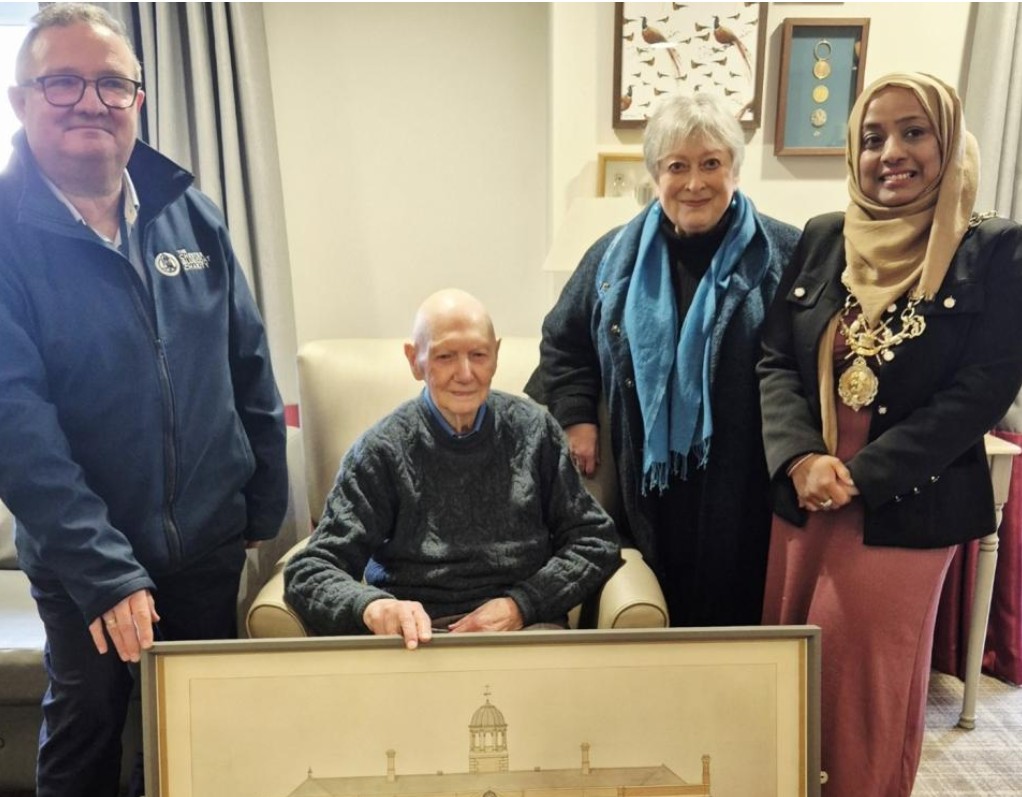
LtoR: Chief executive officer at Chester Bluecoat Charity Mike Jenkins, Grosvenor Manor resident and architectural preservation hero Cyril Morris, chairman of Chester Civic Trust Christine Russell and Lord Mayor of Chester Cllr Sherin Akhtar.

Day Visit: Tuesday, June 9th 
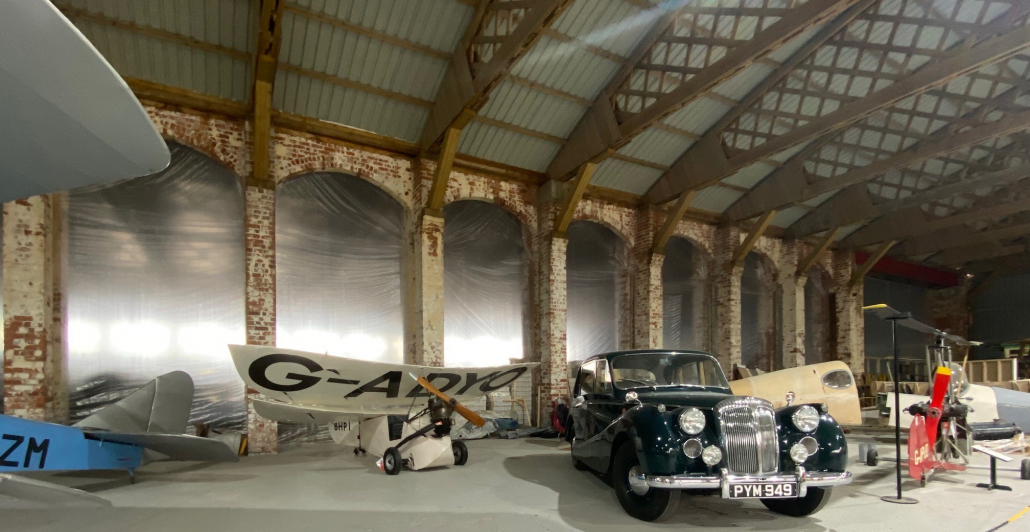
Our day began at Hooton Hangars on the Wirral. Once a home of the Stanley family, it became an aviation centre in both World Wars. It was even Liverpool airport for a few years. The hangars are now a cornucopia of retired aeroplanes. There is a Second World War theme, because of its connection to the Airforce during this period. There is a collection of Victorian printing presses. We had a wonderful guided tour with Cake and a hot drink on arrival.

The hangers are renown for their ‘Belfast Truss’ construction which allow this type of truss to span distances of up to 36 metres, a quality very useful for large open spaced buildings. More information here.

The day continued to Allerton Hall, Sudley House and St Michael’s-in-the-Hamlet, a cast iron church.

This visit is linked to, but independent of, David Mottram’s talk at the BLP on May 21st, 2026.

Photo courtesy of Marketing PRojects.

March 29 – 3 April

A Chester Civic Trust group visit to Gdańsk, a medieval gem on the Baltic coast. In addition to Gdańsk, the flashpoint of WW2, and site of the Solidarity Shipyard and WW2 museum, the itinerary included day visits to UNESCO World Heritage sites like Torun, the birthplace of Nicholas Copernicus, Malbork Castle, Sopot and Gdynia.

Chester’s One City Plan (OCP) was first produced in 2012 and revised in 2022 through a large engagement process coordinated by Cheshire West and Chester Council. Its time period now covers 2022 to 2045 with its vision for Chester as a place ‘that is proud of its history and confident about its future’.

April’s crowded lecture from Andy Farrall provided an expert update on the 45 action areas to be delivered by 2045.  A link to his informative slides is here.

The plan is now in delivery mode, being achieved through 5 partnership delivery groups:

  • Making – development, regeneration, investment, heritage, the environment, green and blue networks, enterprise and skills, digital and the public realm.
  • Connecting – transport and mobility
  • Experiencing – culture and health
  • Visiting – the visitor economy and tourism
  • Being-in – safely, management and maintenance.

More information on the Chester OCP is here: Chester One City Plan – where you can also subscribe to the OCP newsletter.

Speaker Andy Farrall BA(Hons) MA PGDIP MRTPI chairs the ‘Making Group’ – the delivery partnership that is delivering the development, regeneration, economic growth, environment, heritage and investment stream of the Chester One City Plan.

Born in North Wales, Andy is a chartered town planner and urban designer of some 45 years-experience working in the private and public sectors. Starting in South Wales and in the city of Hull, Andy then led the planning and urban design team at London-based Tibbalds working on major commissions across the UK for major public and private sector clients.

Andy was Executive Director, Development and Regeneration at Chester City Council and then Deputy Chief Executive and Executive Director at Warrington Borough Council. He then become Managing Director for Marketing Cheshire and Deputy CEO at the Cheshire & Warrington Local Enterprise Partnership. He now leads his own firm, Andy Farrall Limited, providing consultancy advice for developers, investors, government agencies and local communities. Andy is also a trustee of the Chester Bluecoats Charity and serves on the board of Chester BID.

The talk took place at the Grosvenor Museum on Wednesday 15th April.

6th March 2026 at Bishop Lloyd’s Palace, 2.00pm

Speakers Hough Green Local History Society were awarded one of Chester Civic Trust’s ‘GOOD’ awards this year for their unflagging work into the history of their area. They have published three books to date and are working on a fourth. On top of this they have prepared a new lecture about how they have achieved this.

‘How to Research Your Area’ talked about the use of the written records, such as committee minutes, newspaper articles, street directories and house deeds to tell local stories. Also, how old maps and plans, of varying age and reliability, can be processed to align with modern maps and reveal long lost features. Finally, the showed how the shape of the landscape itself, derived from modern LiDAR data, can reveal secrets of the past.
The Hough Green Local History Group, including Ray Carpenter, Pam Corkerton, Carol Farrell and the late Mike Lloyd, has existed for the last 12 years. Carol Farrell has worked at University of Chester and Ray Carpenter worked in the Research and Development part of a major oil company. Both currently live on Hough Green.

Refreshments followed the talk which cost £6.95.

Dr Abigail Lloyd from the University of Nottingham gave a fascinating talk on March 18th on Place-making with time-depth and connection: how to use historical place-names in modern developments. 

Link here to photos from the talk.

New housing and development schemes are often controversial and challenging to deliver. Communities may feel a keen sense of loss as the landscape around them changes. The names chosen for the new streets can feel bland, homogeneous, and commercially driven. The Institute for Name-Studies, based at the University of Nottingham, is the home of the Survey of English Place-Names, a British Academy project carried out by the English Place-Name Society for over a hundred years. Recently, researchers from the Institute partnered with GeoPlace LLP (a partnership between Local Government Authorities and the Ordnance Survey), as well as four specific local authorities, including East Cheshire, to demonstrate how to use rigorously researched historical place-names in modern street naming. This talk will explained the project (as well as other related research at the Institute), its results and future possibilities, including the legislative framework, involving street naming and numbering officers, and national policy requirements. Historical names represent a rich seam of evidence which enable us to bring to life the particular, distinctive, local character of a place and its past, its communities, their language and stories. This talk really illustrated why it matters.

Biography: Abigail comes from a varied background, including practice as a Commercial Chancery barrister. She now researches the historical landscape, using place-names in particular to aid understanding. Her PhD – When is a hill not simply a hill? Looking again at nuance in (early) medieval place-names – focussed on the relationship between hills and medieval settlement and farming in historical place-names, shedding light on various linguistic communities along the way. She has published on this topic as well as on the importance of using field-name material in the HER.

She has been involved in the planning system, both secular and ecclesiastical, in various roles, including as a DCMS appointment to the Statutory Advisory Committee, as Chair of the Oxford Diocesan Advisory Committee and running the University of Oxford’s public inquiry course. At the Institute for Name-Studies, she partnered with GeoPlace LLP and various local authorities to explore the use of historical place-name information in street naming for modern developments.

As a research associate at the University of Nottingham, she has been developing the national digital database of historical place-names, including GIS-mapped web applications, whilst, at the University of Cambridge, she has been involved in a project mapping the location and perception of historical wetlands prior to drainage.  Abigail is usually to be found sinking into an upland bog, looking for a view!

Friday, 13th of February turned out to be an auspicious day for the group of members, who visited Lytham Hall and the newly refurbished Harris Museum and Art Gallery. The latter was so popular that many members felt they would return later in the year.

As well as having a large collection of paintings, perfume bottles and a Foucault Pendulum, the gallery has a local history section. The model of the huge Horrockses’ factory and an exhibition of its products was quite a talking point. The factory began in 1791, mainly producing cotton products. It gradually expanded, chiefly continuing with this cotton tradition.
In 1946 it brought out its first collection of ready-to-wear fashions. These became instantly popular.

They made everything in women’s cotton clothing from shirtwaisters to evening dresses. This huge popularity was sustained from 1946 to 1964. Interest began to decline then, even though fashion products were produced until the 80s. The firm also diversified into bedding and many of us remembered the sheets, which they produced.

It was the fashion, which members particularly remembered. Here we have a photograph of one of our members on a family picnic. They are all wearing
Horrockses’ dresses. Mary Allinson is the youngest in the centre . She remembers her dress was blue. Also included is a pink Horrockses’ cotton dress. This is on display at the museum.

The location of the mill is now being developed for housing.

Our February Lecture

Thomas Rickman and Chester

Wednesday, 18th February 2026   7.30pm.

Our February lecture by Alex Buchanan explores the formative role that Chester played in the thinking of one of the most influential figures in the study and revival of Gothic architecture, Thomas Rickman (1776-1841). Celebrated for his innovative use of iron in Liverpool’s St George, Everton and St Michael in the Hamlet, Toxteth and at St Mary, Birkenhead, Rickman was also a pioneering scholar. His classification of medieval architecture, An Attempt to Discriminate the Styles of Architecture (Liverpool, 1817), provided key terminology still used for architectural description today. It is less well-known that Rickman developed many of his ideas through close observation of Chester Cathedral and other local buildings during visits from 1808 onwards. The lecture traces Rickman’s encounters with Cheshire architecture, showing how the city and its locale helped him to recognise patterns of stylistic change over time. In doing so, it reveals Chester’s importance in shaping a new, systematic way of understanding England’s medieval past and kicking off the Gothic revival.

Alex Buchanan is Reader in Archive Studies at the University of Liverpool, where she is Programme Director of the Masters in Archives and Records Management. By origin an architectural historian, her architectural research has focused on Gothic architecture and its scholarly reception. She currently serves as secretary of the Construction History Society and President of the British Archaeological Association and is an observer member of the Strategic Treasures Advisory Group at Chester Cathedral.

The lecture will take place at the Grosvenor Museum Lecture Theatre at 7.30pm.

Civic Trust members have FREE admission to the lectures at the Grosvenor Museum. Guests are welcome £5 on the door.

If you read the December 2025 newsletter, you will know that a party of forty Civic Trust members visited Bradford for its Year of Culture. We went to the Cartwright Art Gallery to see the Turner Prize entrants and chose our winner. Zadia Xa gained 24 votes and was the Civic Trust’s winner with Mohammed Sumi gaining 12 votes.

Nnera Kalu was the least appreciated with one vote. Congratulations to this anonymous member as she was this year’s Turner Prize winner.

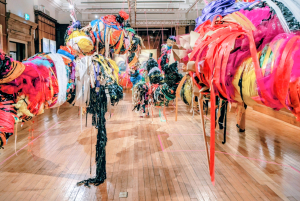
Displayed in her own room, the centre of the exhibition space was dominated by a large number of her big textile structures. These are created from a basic tube skeleton around which are wrapped fabric, paper, cling film and rope. She has referred to them as nests or cocoons.

Around the walls of the room were her drawings, reflecting these textile sculptures. They consisted of swirling lines with bright backgrounds.

Congratulations to the member who was in tune with the exhibition’s judges. Thirty-nine of us disagreed.

More background information on the Turner Prize here.